The Story of a Butte Walldog: Frank G. Meinhart, Sign Painter and Artist

“Walldog” is an old term for the sign, mural, and billboard artists who painted large scale advertisements on the sides of buildings throughout the country.  You can still find haunting evidence of their work in many of the cities and towns of Montana.   Uptown Butte is a particular treasure trove of these “ghost signs”.

These old advertisements are not usually signed, but I recently noticed that a couple of the more distinctive Butte signs that I’ve taken pictures of are signed with the name “Meinhart.”

The first one I noticed was on an advertisement for “Dry Climate” cigars:

union made cigar ad

I was initially focused on the fact that the cigars were “union made”, but then I noticed the “Meinhart” in the lower right corner.

I looked more carefully at my other Butte pictures, and discovered his name again once I zoomed in on an advertisement for Sweet’s Candies:

detail of Butte ghost sign 1

See it there in the bottom center of the sign?  So who was this guy who signed his work when most of his cohorts were content to stay anonymous?

I searched the Montana Historical Society research catalog, and discovered that they have two boxes of information on the Butte signpainter Frank G. Meinhart, including his obituary from May 22, 1947, when he died – by drowning – at age 73.

Frank Meinhart came to Montana from St. Louis when he was a young man, and lived and worked in Butte until about 1927, when he and his wife moved to Hamilton.  He seemed to do quite well for himself: the archives include many letters from the manager of a ranch he owned in the Wise River Valley, as well as references to other land that he owned near Bozeman. In fact, on the back of one of the letters, I found a couple of small sketches that Frank was obviously trying out for the Congressional campaign of Senator Thomas Walsh:

detail of drawings

There is even a little biographical note that Frank seemed to have written about himself in which he notes that he is a personal friend of Charlie Russell and E.S. Paxson, another well-known western artist.   He named his only son Russell, so if he wasn’t a friend he certainly was an admirer.   Tragically, young Russell died at only 8 years old from a tooth infection, and the Meinharts had no other children. The Photographic Archives of the Historical Society have the following picture of Russell, probably taken a couple of years before he died.   It’s an unusual photograph for the time — informal and truly boy-like — and I can imagine that Frank and his wife were thankful they had it:

DSC03363

Frank set up shop at 119 South Main Street in Butte.   The Photographic Archives also have a number of photographs of his work, including one of the interior of his workshop:

DSC03365

Included in the archives as well are a number of photographs of Frank Meinhart’s work and a work-in-progress.   He painted a number of walls for the Sweet’s Chocolates Company.

DSC03371

DSC03372

Looks like they’re painting over an old flour advertisement, doesn’t it? Also looks like they might need the services of “Sam R. White, Undertaker” if they don’t watch their step.   Here are a couple more from the archives:

DSC03368

DSC03366

Frank Meinhart painted landscapes and western scenes in addition to his sign painting work, and I would dearly love to find one of his paintings one day. Might just happen…

Three Generations of a 1905 Eastern Montana Homestead

Update, January, 2013:  Earlier this month the new owner of the Borntrager homestead burned the old house down.   It was not in good shape, so the decision is understandable, but it’s sad.  The house was my husband’s grandparents’ house, and was the home where his mother and his many aunts and uncles grew up.    So this post is in memory of the original Mennonite homesteaders and the wonderful house they built and lived in for nearly a hundred years. 

(The following information on the Borntrager homestead is based on the chapter on Mr. and Mrs. Glen Borntrager in the wonderful book As I Remember…Stories of Eastern Montana’s Pioneers, by Mrs. Morris (Glady Mullet) Kauffman.  Vol. 1.  Glen and Cora Borntrager were my husband’s grandparents.)

Glen Borntrager, 16 years old

On an afternoon in September, 1905, 19 year old Glen Borntrager and his father Joe loaded up their wagon in Glendive, Montana, and headed out for Thirteen Mile Creek, about 30 miles to the northwest.   It was a long trip, and when they reached Morgan Table and were overlooking the valley, Glen was not impressed. He thought that turning around and going back was their best option.  The yipping coyotes were not reassuring, either. But Joe knew that there was no reason to go back.

He had sold off his land and belongings in Illinois, and had hired Isaiah Kauffman to build a house for the Borntrager family on the homestead on Thirteen Mile Creek.

And this was not the typical homesteader’s shack.  The Borntrager house was a well-built two story, Prairie-style farmhouse.

The Borntrager farmhouse in the 1940s

Joe Borntrager left Fayette County, Illinois to homestead in Montana. He homesteaded his quarter section, and within a couple of years Glen filed on a quarter section just north of his father’s section. The Borntragers were Mennonite, and there were other Mennonite families in the neighborhood, including the Eli Chupp family. Glen courted Cora Chupp, and they were married in 1907. They spent their whole married life in the farmhouse that the Borntragers had built in the summer of 1905.

Glen had four brothers and one sister, but he was the only one of them who stuck it out in Montana through the rough years of drought, cold and grasshopper infestations.  He and Cora had seven children: Floyd, Elmer, Oscar, Mahlon, Esther, Lillie and Lena.   Floyd took over the family farm, and farmed until old age, when he moved into Glendive.   Lillie and Lena – who were twins – both married and stayed in the farming

Lillie and Lena in 1920

community that they grew up in, while Esther married a Mennonite preacher and moved to western Montana.   Oscar and Mahlon both farmed in the area, and Elmer became a Mennonite preacher at the little church that his father had helped build.   The church, which was called Red Top because of its red roof, is still there today.

My husband’s mother Lillie, and her husband raised four boys not far from the home she grew up in.    Here they are in 1957, along with Grandma Cora:

A Winter Search for Estella’s Cabin: Looking for the Belmont Mine

Estella and William Muth lived in the tiny mining town of Belmont, Montana in 1881.  Belmont no longer exists, but I did find the Belmont Mine on a map, and today we decided to put on the snowshoes and see if we could find the mine, and maybe even a cabin or two.

We started off at Ottawa Gulch, right above the town of Marysville.  Marysville was a booming town of about  4,000 in the 1880’s, and Estella Muth often mentioned heading “downtown” from her house in Belmont.  Marysville had a drug store, grocery, churches, a number of saloons, and a post office, which was serviced by a train that came from Helena.   Today fewer than 200 people live there.

We snowshoed uphill, working our way southwest through the forest, and after about an hour of hiking we found a small structure:

 Not sure what this building was used for, but right below it was a small stamp mill:

The "stamps" inside the mill: used to crush the ore

The stamp mill crushed the ore so that the gold could be extracted.  Large stamp mills must have been incredibly noisy; the stamps pounded on the ore day and night.   I’m sure that the pounding of the crushers was a constant soundtrack to Estella’s life in Belmont.   Indeed, Estella mentioned in her diary that the mill kept running even after the six men were killed in the “Belmont disaster.”   The Belmont stamp mill was a large one, with 30 stamps, and I learned today that it was destroyed in 1944 as a training exercise for a demolition team from nearby Fort Harrison.  So this little mill that we found was not the one for the Belmont Mine. Nonetheless, it was an interesting discovery.  Here are some more pictures of the stamp mill:

Interior: the big chute for the ore

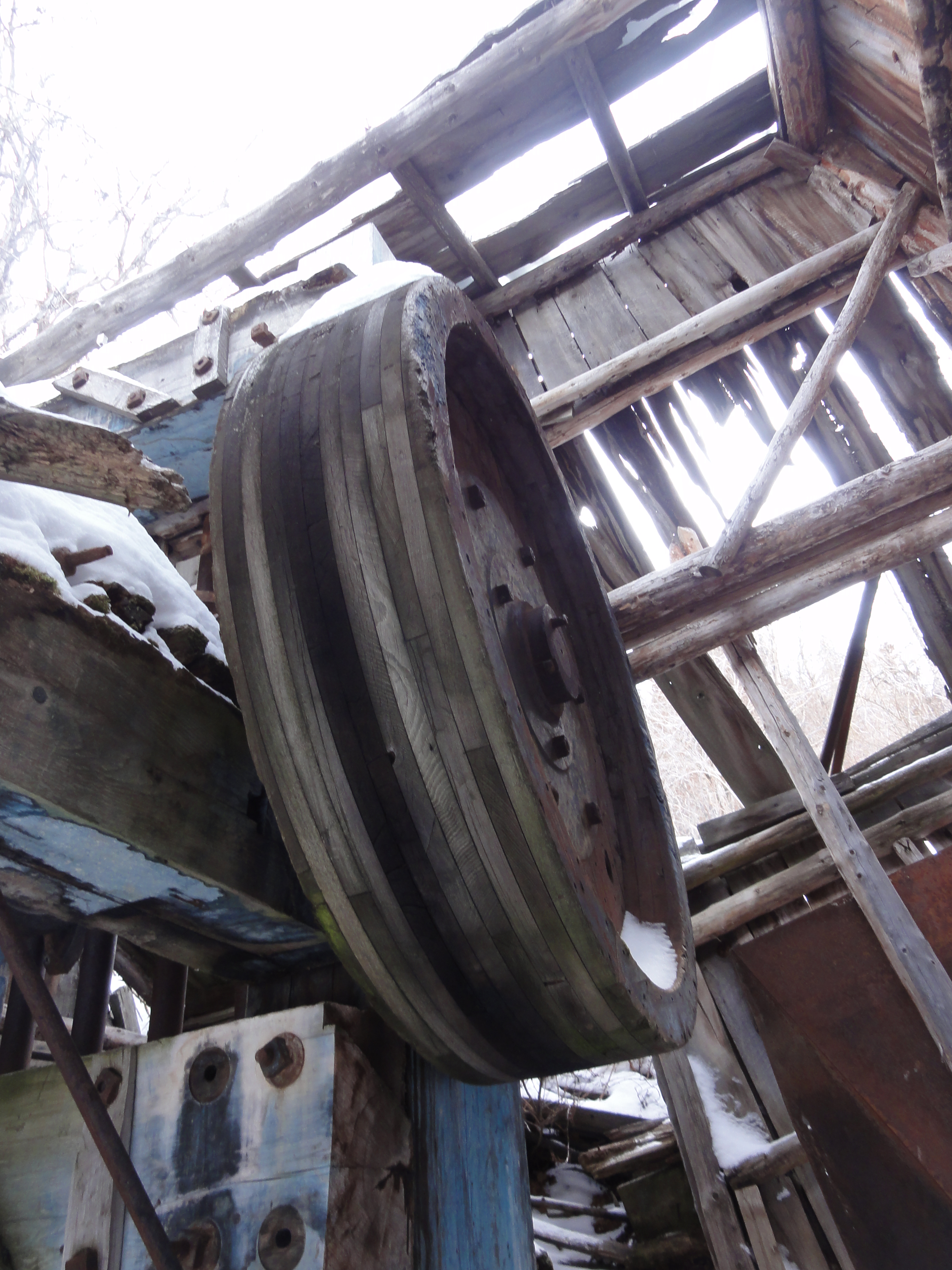
Big wheel for the flat belt that transmitted the power from the steam engine

Another shot of the interior

We didn’t find any standing cabins on this trip, but we plan to return in the summer and continue the search!

If you’re interested in more detail about how the stamp mill worked, Wikipedia has a great article.

Here are a couple of shots of Marysville today:

Estella Amanda Muth’s Diary

What would it have been like to be a 25 year old wife and mother, living in a tiny Montana mining town in 1881?

Estella Muth’s diaries give us a glimpse into that life.   Estella was married to William Muth, a businessman who had moved to Helena in 1873.  In 1880, according to the census, he was working as a “merchandiser” in the little town of Belmont, Montana, about 20 miles from Helena.   His life intersected with Isaac Greenhood’s in 1893, when he was named the receiver for the property that Ike lost to the Merchant’s National Bank.

Estella Hoyt and William Muth were married in 1875, and in 1880 they had two children: Bess (3) and Roy (6 months.)  The household in Belmont also included a servant named Minnie, who was 17 at the time of the census.  There were about 250 people in the little town of Belmont in 1880, mostly miners and laborers, along with the occasional butcher, carpenter or blacksmith.  The town was definitely mostly men,  but the census does list 16 women in addition to Estella who were “keeping house,” so she did have other women to talk to.     Estella and William eventually had two more boys:  William Herbert and John Freeman.   Before she married, she graduated from Helena School District 1, where she was noted as “a model student in every respect.”     I wasn’t able to find any photographs of her, but here’s the Estella of my imagination:

Estella’s diaries reveal an intelligent, curious, and occasionally self-critical young woman.   Here’s an entry from January 30, 1881:

“Sunday.  As usual kind of a loafing day.  Nothing done.  Wish I could employ my time better.  What am I good for?  Knowing there is a God, I fail to serve Him.  Will he be any better to me?  I hope He may.  I will try to do better in the future.” 

She also seemed to suffer from fairly chronic ill-health. Many of her entries in 1881 concern her tiredness and a general malaise, and she occasionally complains that Will is not as understanding as he could be:

“Will thinks there is nothing the matter with me.  I wish he could have a little sympathy for me.”  (February 15, 1881)

Despite not feeling well in February, Estella and Minnie planned a birthday party for Estella’s 25th birthday on February 11, which included baking all day on the 9th.  Her birthday, however, did not go as planned:

February 11:  “My birthday. (25 years old.) The most terrible one I ever spent.  At four this morning Mr. Trent came and woke Will.  Told him the mine was on fire.  The men came out to eat their lunch at midnight.  They made a fire to warm it and went back to work leaving their fire burning.  It caught the blacksmith shop.  They smelled smoke and two of them rushed through the fire and escaped.  Another tried to follow, fell, and was burned to death.  There was great excitement all day.  Toward night they got to where the men were and found five dead.  The other body was not found.  The men were Tom Woods, Pat Laughlin, Hugh McDonal, Breslin, James Keegan, and Jack Shorter.  The men who escaped were Dan McKay and E. Innis.  It has only burned No. 3 and will not stop the work.  The mill stopped until after the men are buried.  I also gave up my birthday party.  Everyone seemed to feel it so much.  There is much sympathy for the widows, Mrs. Woods and Mrs. Laughlin.  They are little more than brides.  It is called the Belmont Disaster.” 

There is something touching about the detail Estella included in this entry, and the way she made sure to list the names of the men involved, as well as their wives.  But she sounds like the young person she is when she adds “I also gave up my birthday party.”

Estella’s days are mostly taken up with sewing, and helping Minnie with the baking and washing.  It seems that Minnie does most of the cooking for the family, since Estella never mentions preparing any meals.  She attends the “Ladies Society”, and church, and occasionally attends theatre productions that she usually enjoys.    She seems to enjoy being in the outdoors, because her longest entries include details of horseback rides or picnics.  For example, June 23rd, 1881:  This afternoon went down town and out to ride to a lovely place near the Diamond Springs.  There was a stream of spring water and some nice trees.  Did not get home till half past eight.”    And on July 1st:  “The warmest day yet.  We went for a picnic.  I never suffered so much with the heat in Montana.  The comet is still beautiful at night.”    [Note: I did a little research, and in1881 there was a comet that was visible in the western United States for most of June and July.]

She also writes a detailed entry about an eleven day fishing trip that she and Will took in August, 1881, up Canyon Creek, during which they “had so much fun.”  They read around the campfire at night, the men did the cooking, and even though the road was rough and frightening, Estella had a grand time.   She finishes the entry with “All things must end, and our fishing trip is at an end.  When will we see another?”

In October, Minnie married and moved back East, which was difficult for Estella.  The following July, she wrote:   “I never missed anyone more than I missed her.  She was always so good to me.  Since then I have had almost as many girls as there have been months.”

I don’t have a picture of the Muth’s Belmont home, but here’s what it might have looked like:

Estella continued to keep her diary sporadically through 1886, with particularly detailed entries whenever she and Will took fishing or camping trips to Canyon Creek or the Blackfoot River.  In 1886 they moved back to Helena, building a large home there in 1889.   In August of that year  she and Will went on a 10 day trip to Yellowstone National Park, and Estella kept a wonderfully detailed diary of that trip, as well.  The Muth house in Helena is still standing.   Here it is:

Estella died on December 29, 1905, from diptheria, just a week after the death of her son John Freeman, also from diptheria.  She was 49.


Ignatz Weil: from Vienna to Helena to Sandpoint

Ignatz Weil, the salesman who supposedly had a mortgage on Ike Greenhood’s house and land on Dearborn Avenue, was one of a number of travelling salesmen who worked for Greenhood, Bohm, and Company.   According to his biography in the  History of the City of Spokane and Spokane County, 18 year old Ignatz immigrated from Vienna, Austria to San Francisco in 1871.  In 1882 he moved to Helena to work for Greenhood and Bohm.    Ignatz travelled all over Montana and northern Idaho, hauling trunks of samples and soliciting orders for the the clothing, tobacco, and liquor that Greenhood and Bohm sold.    And we was busy.    His letters to Ike Greenhood from his trips are in the Greenhhod, Bohm and Company records at the Historical Society, and he seemed to be rarely back in Helena. In fact, in the City Directories from the mid 1880’s, his address is listed as “on the road.”   He wrote to Ike nearly every night, reporting on his latest sales.  Here’s an excerpt from one of his 1887 letters, written from The Grand Hotel in Billings:

“Dear Ike,

I arrived this evening from Melville (?) and herein enclose Hickox order amounting to $1800.  On account of high water I could  not go to Melville…will stop there however tomorrow on my way back….I will go tomorrow to Big Timber, next day to Bozeman or Helena.  Sold so far on this trip a trifle over $10,000.”

And here’s a photo of the letter:

Can anyone decipher the name of the town Ignatz couldn't get to?

$10,000!  That’s a lot of cash in 1887 dollars.  He seemed to be one of Ike’s top salesmen, and from the letters the two exchanged it’s clear that they liked and respected each other.  Many letters include questions about the Greenhood children, and Ignatz often gave Ike advice about running his business.  Indeed, between 1889 and 1891, the Helena City Directory shows Ignatz boarding at the Greenhood residence on Dearborn Avenue (our house!)

In 1891 Ignatz left Helena and headed for Sandpoint, Idaho, with the intention of going into business for himself.  He was in Sandpoint on that February evening in 1892 when Isaac was busy mortgaging his property to Ignatz.  Ignatz stayed in Sandpoint, and ended up becoming one of the founding fathers of the town.  According to the History of the City of Spokane and Spokane County, which was published in 1912, Ignatz Weil “has acquired extreme holdings in the property of this vicinity…and is recognized as a man of clear judgment, foresight, and rare business sagacity.”  In 1900 he became the United States commissioner of the district, and in 1907 he was appointed the auditor, recorder and clerk of the district court.

The biography also notes that Ignatz married “Miss Irene Henry, of Kentucky” in 1886.  Ignatz was still in Helena at that point, but I cannot find any mention of Irene in either the Helena city directories or the Helena newspapers.  They were probably listed in the 1890 census, but since all records of that national census were destroyed in a fire, we don’t have access to that information.  By 1900, however, both Ignatz and Irene are listed in the Sandpoint, Idaho census.  I did find a picture of their Sandpoint home:

Pretty nice, eh? Not bad for an immigrant boy who arrived at 18 with pretty much nothing to his name.

Ignatz died in 1931 and Irene in 1945.  They had no children, and both are buried in Sandpoint:

Max Kahn, Ignatz Weil, and legal troubles for Isaac

On the evening of February 12, 1892,  Ike and Sallie Greenhood were busy at the Lewis and Clark County Recorder’s office, filing a mortgage on their property on the west side of Helena to Ignatz Weil, one of the key salesmen in the firm of Greenhood, Bohm and Company.   With them was Max Kahn, a bookkeeper for the firm, who served as a witness to the transaction, and the recorder, J.S. Tooker, as well as the Deputy Recorder, S.O. Danforth.   It was 8:50 p.m., well past normal working hours for the Recorder’s Office.  Specifically, Isaac mortgaged “lots 2 and 3, Blook 18 of the Storey Addition”  in Helena, for two years, and if the loan was not paid back at that time, Ignatz Weil could claim the property.   Ignatz Weil was not present.  In fact, he was not even in Montana at that time.

A photograph of the original mortgage document that was filed at 8:50 pm on February 12, 1892

If the late hour for this transaction doesn’t make it suspicious, the events of the next day certainly do.  On February 13, 1892, the Merchants’ National Bank filed a complaint against Isaac Greenhood and Ferdinand Bohm for the recovery of $35,945.48 that Greenhood, Bohm and Co. owed the bank.  In the legal action that followed, Greenhood and Bohm were accused of making a  “pretended, fraudulent, and fictitious assignment of their debts” “for the purpose and with the intent to hinder, delay, and defraud this plaintiff and the other creditors.”   The quickly executed mortgage on Isaac’s home is just a piece of the story, and Max Kahn plays an important role.    According to the summary of the legal case (Merchants’ Nat. Bank v. Greenhood et al., Review on Appeal, Supreme Court of Montana, July 22, 1895, The Pacific Reporter, Vol.41),  Max Kahn was assigned the job of outlining Greenhood and Bohm’s assets, and listing the creditors to whom Greenhood and Bohm had obligations.  The accusation is that the report Max prepares is so woefully inaccurate that it amounts to fraud, and that the mortgaging of the property on February 12 was also “fictitious” and fraudulent.

The trial lasted 21 days, and was, according to the Pacific Reporter, “long, laborious, and hotly-contested”, and resulted in 60 separate “findings of fact” by a jury of “unusual intelligence.”   Basically, the court found in favor of the Merchants’ National Bank, and the property owned by Greenhood and Bohm was put in care of a court-appointed receiver.  Max Kahn is described in one of the findings as “a man without means, and pecuniarily and wholly irresponsible”.  The next finding states that Isaac Greenhood and Ferdinand Bohm asked Max Kahn to make the assignments with the “intent to hinder, delay, and defraud and plaintiff….and other creditors.”    The court was kind to Ignatz Weil, however, and found that he knew nothing of the execution of the mortgage on the Dearborn property, and he was therefore not implicated in the fraud.

So, Isaac Greenhood built his house on Dearborn Avenue in 1888, and by 1892 he was busy hiding the property from the bank.    The trial took place in April, 1892, with the judgment in favor of the bank, but Ike and Ferdinand appealed to the Montana Supreme Court, which didn’t render a decision until July of 1895.   The court-appointed receiver took over ownership of the property in 1895, but the Greenhoods continued to live in the house until 1897.  It looks like Ike Greenhood, to whom I’ve become pretty attached, was actually not such an upstanding guy!

I’m not sure what happened to Max Kahn after the trial, but Ignatz Weil, who had actually set himself up in business in Sandpoint, Idaho by 1891, went on to become quite successful.  I’ll continue his story in my next entry.

Discovering Isaac Greenhood

When I attended a workshop at the Montana Historical Society on “Researching Your Montana Property”, my intent was to come up with a chronology of the owners of our 120 year-old house.  Once I started the search, however, I ended up going in a whole other – more fascinating –direction.

The State Historic Preservation Office  gave us a research guide  that included info on starting a title search,  looking at wills and tax records, and accessing old city maps.   I spent a number of happy hours searching through the old Sanborn company fire insurance maps that are available on line for every town in Montana.  The Helena maps begin in 1884, and are very easy to use.  Once I saw the little outline of our house on the 1888 map, I was hooked.

After that interesting detour, I planned to start a title search.  This job was made much easier because a friend had actually already made the initial stab at a title search on our house – so that step was already well under way.    With this information I could see that our property was actually a homestead grant from the US government to George W. Storey.

But I was interested in the first owner and builder of our actual house, not just the land.  Through the title search we discovered that the owner of the house in 1888 was named Isaac Greenhood – and the Sanborn maps confirmed that there was no house on the property in 1884, but one was there in 1888.  So, great information so far.

Isaac Greenhood's house. The porch was added some time after 1890.

Isaac Greenhood sounded like a Jewish name, which prompted my first ever trip to the Jewish Cemetery in Helena (located behind Capital High School.)     There I found headstones for the whole Greenhood family:  Isaac, his wife Sallie, and their children Benn and Dora.  Now this was really exciting. These were real people, who had actually lived in the same house I was  living in.  I had to find out more of their stories.   What was their everyday life like?  What did Isaac do for a living?  What was Sallie’s story?  What happened to their kids?  How’d they end up in Helena, anyway?

I started with the old City Directories at the library.  Isaac Greenhood was listed in the 1889  directory, living in our house.  That in itself was pretty nifty, but it was even more exciting to see an ad for his business:  “Greenhood , Bohm and Company, Wholesale and Retail Clothing, wines and liquors.”  I now knew how Isaac made his living, and I could even see where his store was – at 24 and 26 S. Main Street.  By looking at subsequent directories I could even see how long Isaac lived in our house (until 1897) and watch as his business expanded:  in 1891 the business took up space at 23, 26, 28 and 30 S. Main Street.  I could even tell that the business was no longer in operation by 1897, because Isaac was now working as a Department Manager for another retail company, and he had moved to a hotel in town.  This brought more questions.   What happened to his store?  Why’d he move from our house?

Next stop: the Montana Historical Society.  Since I knew from his headstone that Isaac Greenhood had died in September, 1902, I wanted to look at the Helena papers from that time to see if there was an obituary for Isaac.   The staff at the  Research Center showed me how to use the microfilm machine, and after a bit of searching I found a nice long obituary for Isaac Greenhood.  Apparently poor Isaac “dropped dead” in New York City while on a buying trip for the clothing company he and  his son Benn had started.  The obituary said that Isaac (or Ike, as I discovered his friends called him) had arrived in Helena on a mule in 1866, with only $1.25 in his pocket.  His business cohorts described him as “a good man, who had a genius for merchandising.”   This was a great find, and I was really starting to get a sense of what this Ike Greenhood fellow was
like.

The staff of the Research Center suggested that I check out the Photographic Archives, which was my next step.  I thought I might be able to find photos of the Greenhood family, or of the house when it was first built, or even of Isaac’s store on S. Main Street.  Once again, the staff was very helpful, and I found pictures of both of the children when they were about 4 and 7, and even a very cute one of Benn as a baby.  The most exciting find, however, was a photograph of South Main street that  includes a clear picture of the Greenhood, Bohm and Company store, with the company name across the top of the second floor. (Once I have permission from the Historical Society, I’ll add these pictures to my post.)

The first Greenhood, Bohm and Company store in Virginia City. The location of the Helena store was about where Broadway now crosses Last Chance Gulch.

Next I searched the Research Center’s on-line catalog and discovered that they have “14 linear feet” of records from Greenhood, Bohm, and Company.   The guide to the records includes an “historical note” that explains that the company declared bankruptcy in 1892, which also clarifies why the Merchant’s National Bank took over ownership of Isaac’s house in 1893.  The legal arguments over the ownership of the house weren’t resolved until 1897, which is probably why the Greenhoods lived in the house until 1897.

The company records include boxes and boxes of correspondence and financial records that deal with the everyday operations of the store. For my purposes, though, two folders were most interesting: one with Isaac Greenhood’s diary, and another that includes personal correspondence to Isaac.  The diary, from 1878, includes entries about Isaac’s business dealings, including a few notes about his partnership with Ferdinand Bohm, notes about the weather, and even a few entries about his concern about his son “Benny’s” cold, and his visits to Dr. Brooke, and to the Parchen store for a prescription for Benny.  There weren’t a lot of entries, but they added more detail to the picture that was emerging of what this man was like.

But the letters in the next folder really added to my understanding of Ike Greenhood.  There was a September, 1877 letter to both Ike and Sallie from Sallie’s parents in Newburgh, New York.   In the letter it was clear that the parents were caring for Sallie’s sister Bertha and her children, and that they were not at all happy that the father of the children – Felix – was in Montana and not sending any support for them.  The parents asked Ike to talk to Felix and “tell him to send for them as soon as possible for I can’t keep them any longer….he don’t even write to her and don’t send her no money.  She has got very  little money since she was here.”  Ah…a little human drama to flesh out the story even more.  To continue the drama, the next letters were from Felix to Ike, while Ike was apparently on an extended buying trip.  Through these very poignant letters, it was clear that Felix was actually staying with the Greenhoods, and helping out at the house while Ike was away, and that Felix was feeling inadequate and depressed about his continuing hard times.  In the first letter (February 16, 1878) Felix is a little hopeful that he has a connection that will allow him to raise some money, for, I assume a business venture.  But he obviously is not overly hopeful: “All this may amount to nothing.  I have met with so many disappointments of late that I trust to nothing until I have it.  I  should think that with your staying in San Francisco you might get me established in a good credit if I could only raise a few thousand dollars.”

But, by the next letter on March 6, Felix has decided to leave the Territory.  Here is an excerpt from that letter:  “…now there is nothing left for me to do but to quit the territory if I can get money enough to leave with.  I cannot see anything for me in Montana…God knows that I have tried enough.  I cannot try any more.”  You can’t help but feel for this poor guy, who, even in his depressed state, goes on to give Ike an update on how Ike’s son Benny misses him, and that Dora has had a little sore throat, but “nothing dangerous.”

So, I now was drawn into not only Ike Greenwood’s life, but this Felix character as well.  But I didn’t have any idea who Felix was.  He clearly was married to Bertha, and it seemed likely that she was Sallie’s sister, but I didn’t see how I could figure out Felix’s last name.  I puzzled on this on and off for a few weeks, until one day I had an idea:  if Felix was in Helena in 1870, I could browse through the 1870 Helena census and see if I could find a Felix listed.  The census is available at the Historical Society through Ancestry.com, and you can just scroll through the list of names.   I pulled up the 1870 census, and on the third page I found exactly what I was looking for:  Felix Ponansky, living in Helena with his wife Bertha, their three children, and a 16 year old girl named Sallie Abrahams!

Original image of the 1870 Helena Census, listing Felix and Bertha and their family.

I knew from the earlier letter that Abrahams was Sallie’s maiden name.   Not only had I found Felix, but I’d stumbled upon how Ike and Sallie had probably met: Sallie most likely came west with her sister to help her care for her children, and met Ike when she arrived in Helena.  Just conjecture, of course, but the pieces of the puzzle were falling into place.

Felix and Bertha are not listed in the 1880 census, so it appeared that Felix did leave as he said he would in his March 6, 1878 letter.  I was still curious, however, about what happened to Felix.  I checked the census records for the Rapid City, South Dakota area (because of his Black Hills reference), but found no Ponansky listed. There were, however, Poznanskys, including Felix and Bertha and their children.  Now that I knew their real name and where they lived, I was able to discover that Felix  ended up doing pretty well for himself, opening a store in Rapid City, and becoming one of the leading citizens of the town.    It’s surprisingly safisfying to learn that this long-gone businessman actually turned his life around and ended up pretty darn successful.

Next, research on one of Isaac’s salesmen, Ignatz Weil, who wrote some pretty interesting letters to Isaac as well.